
THE 2026 COMPLIANCE COUNTDOWN: WHAT THE NEW EU DESTRUCTION BAN MEANS FOR FOOTWEAR BRANDS

Updated: Jun 25
The 2026 compliance countdown: what the new eu destruction ban means for footwear brands
As of July 19, 2026, the European Union is officially banning the destruction of unsold footwear. This isn't a distant regulation — it's a structural shift that changes how brands plan, produce, and manage their collections. For footwear professionals, the question is no longer *if* compliance is necessary. It's *how fast* you can adapt.
1. What the ESPR Actually Changes
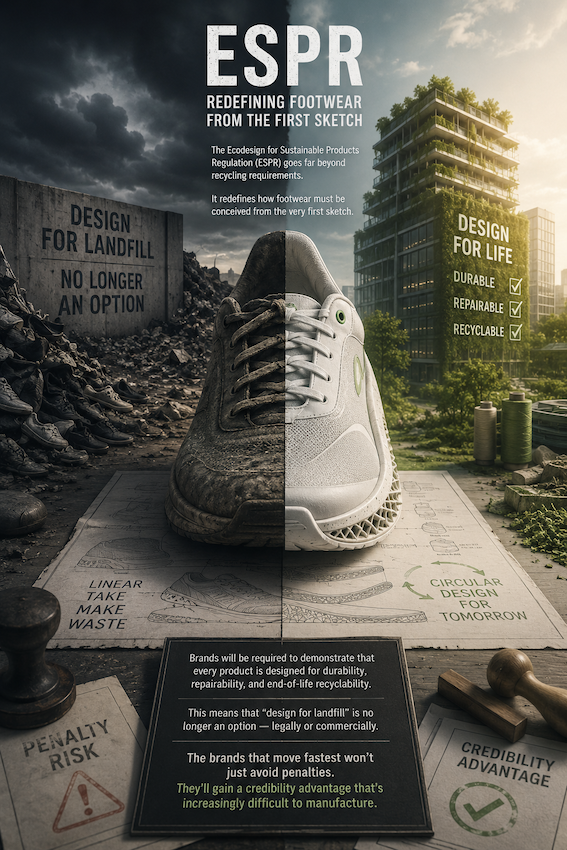
The Ecodesign for Sustainable Products Regulation (ESPR) goes far beyond recycling requirements. It redefines how footwear must be conceived from the very first sketch.
Brands will be required to demonstrate that every product is designed for durability, repairability, and end-of-life recyclability. This means that "design for landfill" is no longer an option — legally or commercially.
The brands that move fastest won't just avoid penalties. They'll gain a credibility advantage that's increasingly difficult to manufacture.

2. The Digital Product Passport: Every Shoe Gets a Story
One of the most significant operational demands of the ESPR is the Digital Product Passport (DPP) — a digital record embedded in every pair that tracks its full lifecycle: materials, origin, manufacturing process, carbon footprint, and disposal guidelines.
For brands, this means full transparency is no longer optional. Every supplier in your chain must be traceable. Every material must be verified. Every production decision becomes part of the public record.
This is where choosing the right manufacturing partner becomes a strategic decision, not just a commercial one.
3. From Mass Production to Agile Manufacturing
The destruction ban doesn't just affect what happens at the end of a product's life — it fundamentally changes how much you should produce in the first place.
The "produce more, sell more, destroy the rest" model is structurally broken. Brands must move toward smaller, more precise production runs aligned with real demand — what the industry now calls Agile Manufacturing.
This model reduces overstock risk, improves cash flow, and directly addresses the compliance requirements of the new regulation.


4. The Supply Chain Audit You Can No Longer Postpone
Many brands already know that parts of their supply chain lack the documentation needed for full compliance. The ESPR makes this audit urgent.
Key areas to review before July 2026:
- Material certifications and traceability documentation
- Supplier environmental compliance records
- Production waste and energy consumption data
- End-of-life material pathways
Manufacturers with robust digital systems and established sustainability practices will become preferred partners — because they simplify compliance instead of complicating it.
5. Why This Is an Opportunity, Not Just a Risk
Regulations like the ESPR tend to create winners and losers — and the line between them is often drawn by how quickly a brand repositions.
For forward-thinking brands, 2026 compliance is a competitive advantage: a signal to consumers, retailers, and investors that your production model is built for the future. The brands that embrace this shift early will own the narrative.

Image 5: Leather waste landfield
The Rodiro Approach
At Rodiro, responsible production has always been built into how we work — not added on top. Our facilities in Portugal operate with a commitment to material traceability, reduced waste, and certified sustainable processes.
As the ESPR reshapes the landscape, we're ready to be the kind of partner that makes compliance simpler — so brands can focus on what they do best: creating footwear that stands out, for all the right reasons.
The countdown has started. Let's move forward together
Follow Us on Social Media for Latest


Comments